What are the identified needs and next steps based on a review of data?
LEAs were asked to describe 1) any areas that need significant improvement based on a review of the site-level APRs, and outcome data, Dashboard indicators, and 2) any steps taken to address those areas.
In Year 3, cohort 1-3 LEAs described using California School Dashboard indicators and local data (local assessments, surveys, and site-level program narratives) to identify persistent gaps and to prioritize a small set of outcomes for improvement. Overall, reflections show a consistent improvement approach: focus on high-leverage outcomes (especially attendance and academic performance) while strengthening the enabling systems—data routines, tiered supports, cross-role coordination, partnerships, and family engagement—needed to make progress sustainable.
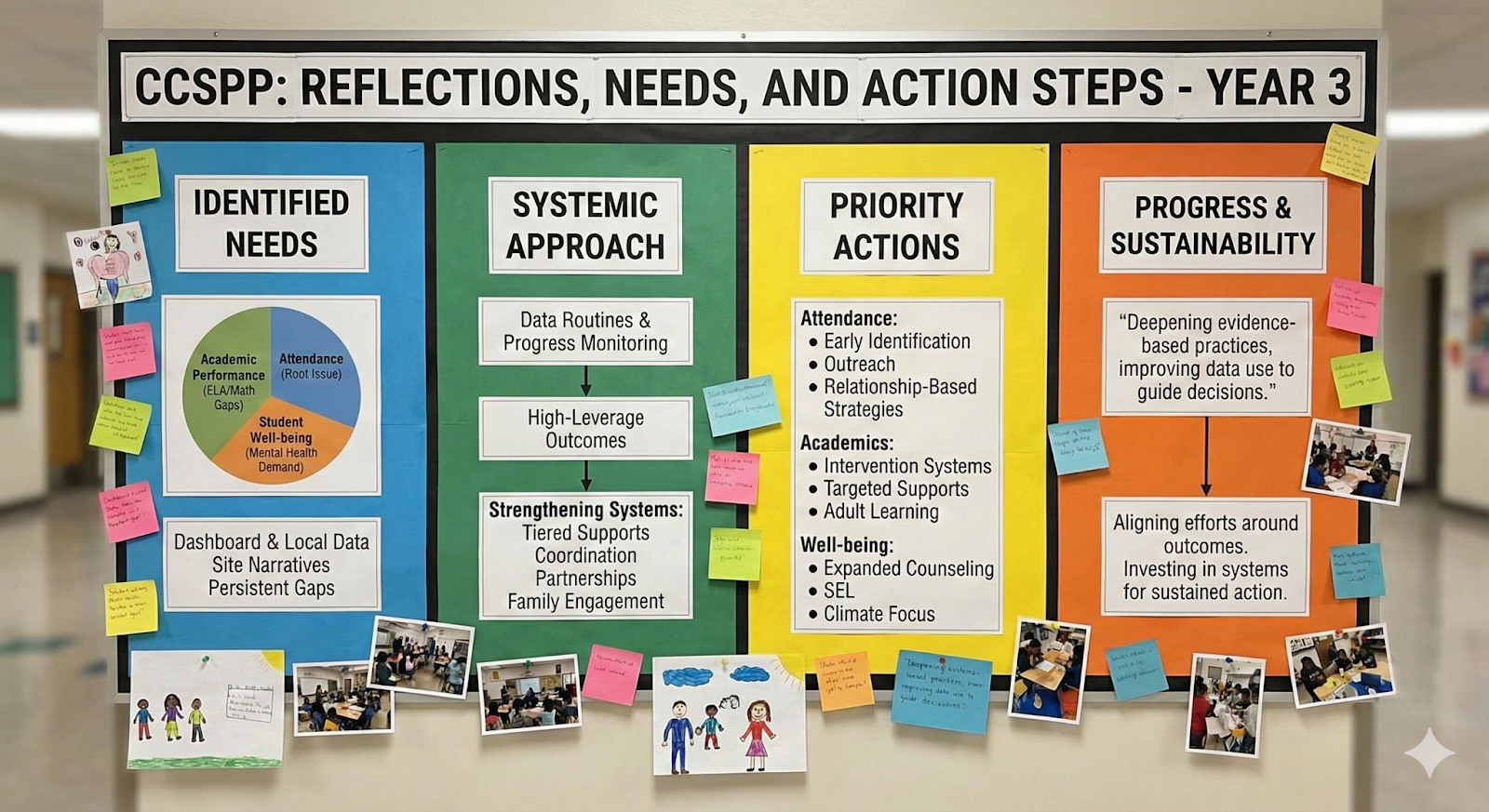
Areas of need identified by LEAs:
Attendance and chronic absenteeism was frequently described as a “root” issue because it limits access to instruction and to community school supports. Responses connected attendance challenges to broader barriers (e.g., transportation and housing instability) and to equity concerns for prioritized student groups. Several LEAs described strengthening early identification, outreach, and follow-up (including case management approaches), emphasizing relationship-based strategies to understand barriers and re-engage families. “These efforts have helped build trust, identify root causes of absenteeism, and connect families to needed services and supports.”
Academic performance in ELA/literacy and math was often paired with concerns about persistent subgroup gaps. Steps taken commonly included strengthening intervention systems and expanding targeted supports (e.g., tutoring, small-group supports, extended learning), along with adult learning supports (professional learning, coaching, and instructional alignment) to improve implementation quality. “While proficiency rates remain a challenge, all sites have reported incremental gains, with coordinated tutoring programs, targeted workshops, and growth-focused incentives contributing to students’ academic development.”
Student well-being, mental health/SEL, school climate, and behavior/discipline were areas where needs remain high and often intertwined with attendance and academic outcomes. A recurring theme is that demand for mental health and counseling support exceeds current capacity. One response illustrates this gap between need and service reach: “Counseling services reached 45 students, though 157 referrals signaled a higher need.”
Data use and progress monitoring were emphasized by LEAs as the mechanism that links “identified needs” to concrete action—strengthening how teams review evidence, set priorities, coordinate across roles, and monitor whether strategies are working. “Schools are deepening their understanding of evidence-based practices and improving use of data to guide decisions.”
Year 3 reflections indicate that LEAs are aligning improvement efforts around a consistent set of outcomes—attendance, ELA/literacy, math, and student well-being/climate—while investing in the systems and routines (data cycles, tiered supports, coordination, and partnerships) that help translate identified needs into sustained action.